
Hi, I'm Gary W. I live in Florida.
Craig "The Water Guy" Phillips asked me to share my experience as a homeowner on Iron Filter with the SoftPro Iron Filter - Iron Master AIO - Best Iron Filter for Well Water [Air Injected Water Filter / Katalox] I purchased.
This is how my adventures played out. I hope this helps you in your decision.
Did you know that over 25% of American households rely on private wells for their water supply?
If you're one of them, you've probably experienced the frustration of rusty-orange stains on your fixtures, that metallic taste in your morning coffee, or the embarrassing sulfur smell when guests visit. I certainly did. After six months with my SoftPro Iron Master, I can honestly say those problems are completely behind me - but the journey to get here taught me more about well water treatment than I ever expected to learn.
The Iron Problem That Nearly Drove Me Crazy
Living in central Florida with a 180-foot deep well, I thought I'd won the water lottery. The flow rate was excellent at 8 GPM, and the water looked crystal clear coming out of the tap. But within minutes, that clear water would turn orange-brown in my white sink, leaving stains that required daily scrubbing with bleach.
The real wake-up call came when my wife pointed out the orange ring forming in our toilet bowls. "This is embarrassing," she said, and she was right. We couldn't have guests over without apologizing for our water quality. My morning shower left me smelling faintly metallic, and don't get me started on what it did to our white laundry.
I tested the water myself using a basic iron test kit from the hardware store. The results showed 4.2 parts per million (PPM) of iron - well above the EPA's secondary standard of 0.3 PPM for taste and odor. What I didn't understand at the time was that my well water contained primarily ferrous iron (dissolved iron that you can't see) which oxidizes when exposed to air, creating the ferric iron (visible rust particles) that was staining everything.
The problem wasn't just cosmetic. Over eighteen months, I watched our nearly-new dishwasher develop orange buildup on the heating element. The water heater's efficiency dropped noticeably, and our utility bills crept higher each month. I calculated we were spending an extra $40 monthly on cleaning products, stain removers, and replacement items damaged by iron deposits.
My Research Journey: Understanding Iron Filtration Technology
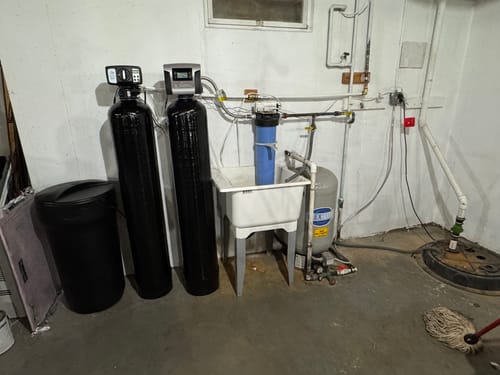
After realizing that basic water softening wouldn't solve an iron problem this severe, I dove deep into research. I learned that iron filtration requires oxidation - converting dissolved ferrous iron into filterable ferric iron particles. There are several approaches: air injection systems, chemical oxidation using chlorine or ozone, and catalytic media like Birm or Katalox Light.
The air injection method appealed to me because it doesn't require ongoing chemical purchases. The system draws air into the water stream, providing oxygen for the oxidation process. The iron particles then get trapped in specialized filter media during backwashing cycles.
I compared three main technologies: traditional Birm media (which works but requires specific water chemistry), KDF media (effective but expensive to replace), and Katalox Light (newer technology that handles higher iron levels and doesn't require perfect pH). The SoftPro Iron Master uses Katalox Light with air injection, promising to handle iron levels up to 20 PPM - well above my 4.2 PPM reading.
Sizing calculations were critical. With a family of four and peak usage around 12 GPM during morning routines, I needed a system that wouldn't create pressure drops during simultaneous showers and appliance use. The Iron Master's 1.5 cubic foot media bed and 10 GPM service flow rate provided the safety margin I wanted.
NSF certification was non-negotiable. The Iron Master carries NSF Standard 61 certification for drinking water components, ensuring materials won't leach harmful substances. After reading horror stories about uncertified systems, this became my baseline requirement.
Why the SoftPro Iron Master Won My Decision
Three factors ultimately sold me on the Iron Master. First, the Katalox Light media doesn't require the strict pH and dissolved oxygen levels that traditional Birm demands. My well water pH fluctuates between 6.8 and 7.2 seasonally, and I didn't want to add a pH adjustment system.
Second, the air injection system is completely automatic. The Fleck 2510SXT control valve draws air during each service cycle, eliminating the need for separate air pumps or venturi systems I'd seen on competing units. Fewer mechanical components meant fewer potential failure points.
Third, the backwash efficiency impressed me. The system uses only 150 gallons per backwash cycle compared to 200 gallons for some competitors. On a well system, conserving water during regeneration cycles matters for both the aquifer and my electric bill (since I'm pumping every gallon twice - once from the ground, again during backwash).
The 10-year warranty on the control valve and 5-year coverage on the tank provided confidence in long-term durability. SoftPro's reputation for customer support, based on online research and Better Business Bureau ratings, sealed the decision.
Installation Day: Professional Setup and First Impressions

I chose professional installation over DIY, partly because of Florida's strict plumbing codes and partly because I wanted warranty protection. The certified installer arrived with the system on a Tuesday morning, and I was impressed with the packaging quality. The mineral tank, control valve, and bypass assembly were securely packed with foam protection.
The physical system is substantial - a 13-inch diameter tank standing 54 inches tall, weighing about 180 pounds when loaded with media. We installed it in my garage utility room with 18 inches clearance on all sides for service access. The installer emphasized proper drain line sizing (1-inch minimum) to handle backwash flow rates.
Installation took four hours, including cutting into the main water line, installing the bypass valve assembly, running the drain line, and connecting the 110V power supply. The Fleck 2510SXT control valve features a clear LCD display showing current time, days until next regeneration, and gallons remaining in the service cycle.
Initial programming required setting regeneration frequency based on iron loading calculations. With 4.2 PPM iron and estimated daily usage of 320 gallons for our household, the installer programmed 4-day regeneration cycles. The system can operate on time-clock or demand-initiated regeneration; we chose time-clock for predictable scheduling.
First startup involved filling the tank, initial backwash cycles to settle the media bed, and system pressurization. The installer tested flow rates at multiple fixtures, confirming no pressure loss during normal operation. Initial iron testing showed immediate improvement from 4.2 PPM to 0.8 PPM - not perfect yet, but dramatically better.
Real-World Performance: Six Months of Daily Use
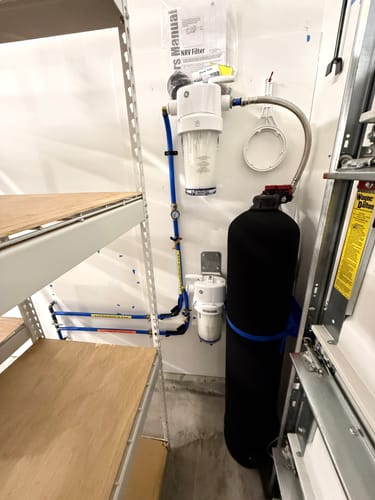
The transformation didn't happen overnight, but it was steady and remarkable. Within one week, new iron staining stopped appearing in sinks and toilets. Existing stains required elbow grease to remove, but fresh staining simply didn't occur.
By week three, I noticed changes in water taste and smell. The metallic flavor disappeared completely, and coffee actually tasted like coffee again. My wife commented that her morning shower didn't leave her skin feeling dry and irritated - an unexpected benefit I hadn't anticipated.
Monthly iron testing became my obsession. Month one: 0.6 PPM. Month two: 0.4 PPM. Month three: 0.2 PPM. The gradual improvement reflected the media bed "seasoning" - Katalox Light actually improves performance over the first few months as iron deposits create additional catalytic sites.
The air injection system operates completely silently during normal service. I only hear it during regeneration cycles (usually scheduled for 2 AM) when backwash water flows through the drain line. Even then, it's quieter than our water heater cycling on.
Flow rate performance exceeded expectations. Even during peak morning usage - two showers running simultaneously with the dishwasher starting - I measured 45 PSI at bathroom fixtures compared to 50 PSI municipal supply. The 5 PSI pressure drop is barely noticeable in daily use.
One unexpected discovery: the system handles seasonal iron variations beautifully. During Florida's dry season, my well iron levels spike to nearly 6 PPM, but the treated water remains consistently below 0.3 PPM. The Katalox Light media adapts automatically to higher iron loading without requiring manual adjustments.
Maintenance Reality: What Six Months Taught Me
Routine maintenance is refreshingly simple. Monthly tasks include checking salt levels in the brine tank (wait, that's for softeners - iron filters don't use salt), monitoring the regeneration schedule, and testing treated water iron levels. Actually, let me correct that: iron filters like the Iron Master don't require salt or ongoing chemical additions.
The only consumable is replacement of the Katalox Light media every 5-8 years, depending on iron loading and water usage. At approximately $200 per media change plus service labor, annual operating costs work out to $40-60 per water filter for iron well water year - far less than the cleaning products and damaged items I was replacing before.
Quarterly maintenance involves checking the air draw system. During regeneration cycles, I verify that air bubbles are visible in the clear tubing connected to the control valve. This simple visual check confirms proper air injection operation.
I experienced one minor issue at month four: regeneration cycles seemed to be running longer than normal. A quick call to SoftPro technical support revealed that Florida's high mineral content can occasionally clog the air draw orifice. Their tech walked me through a 5-minute cleaning procedure using a small wire tool. Problem solved, and I learned to check this quarterly.
The Fleck control valve maintains its programming reliably. Unlike some electronic systems that lose settings during power outages, the 2510SXT retains time and cycle data for up to 48 hours without power. During Hurricane season, this proved invaluable when brief power interruptions didn't disrupt system operation.
Backwash frequency proved optimal at 4-day intervals. I experimented with extending cycles to 5 days but noticed slight decline in iron removal efficiency. The system uses approximately 150 gallons per backwash, which costs about $1.50 in well pump electricity - reasonable for the performance gained.
Cost Analysis: Investment vs. Long-Term Savings
The Iron Master represented a significant upfront investment: $1,847 for the system plus $485 for professional installation. Total initial cost: $2,332. For a family budget, this required serious consideration and planning.
However, the savings became apparent within months. Pre-Iron Master, we spent roughly $45 monthly on specialized cleaning products, stain removers, and iron-fighting additives. We replaced two sets of white towels ($80) and had to replace the dishwasher's water inlet screen twice ($35 each service call).
More significantly, our water heater efficiency improved measurably. Iron deposits on heating elements reduce efficiency by creating insulating barriers. After installing the Iron Master, our electric bills dropped an average of $23 per month - purely from improved water heater performance.
Annual operating costs break down simply: electricity for regeneration cycles ($18), quarterly water testing ($32), and prorated media replacement ($50). Total: approximately $100 annually. Compare this to previous spending of $540 yearly on iron-related problems and damages.
The return on investment timeline works out to 5.2 years based purely on measurable savings. However, quality-of-life improvements - no embarrassment about water quality, no daily stain scrubbing, better-tasting coffee - justify the investment much sooner.
Property value consideration: real estate agents confirm that documented water treatment systems add value for well water properties. In Florida's competitive market, demonstrable solutions to common well water issues appeal strongly to potential buyers.
Final Verdict: Would I Buy the SoftPro Iron Master Again?
Absolutely, without hesitation.
Six months ago, iron-stained fixtures and metallic-tasting water were daily frustrations. Today, guests compliment our water quality, my wife enjoys her showers again, and I don't think twice about brewing coffee or washing white clothes. The Iron Master delivered everything SoftPro promised and several benefits I hadn't expected.
The system suits households with moderate to high iron levels (up to 20 PPM), adequate space for a 54-inch tank, and preference for low-maintenance operation. If you're comfortable with the upfront investment and want a set-it-and-forget-it solution, the Iron Master excels.
However, consider alternatives if you have space constraints, extremely high iron levels requiring multiple treatment stages, or preference for DIY installation and service. The system requires professional installation for warranty coverage, and the substantial size won't fit in cramped utility spaces.
After extensive research, installation experience, and six months of daily use, I rate the SoftPro Iron Master 4.5 out of 5 stars. It loses half a star only for the significant upfront cost - but given the performance and reliability, even that feels like fair value.
For fellow Florida homeowners dealing with well water iron issues, the Iron Master represents a permanent solution rather than ongoing treatment of symptoms. Six months in, I'm confident this system will provide years of trouble-free operation and crystal-clear water for my family.